
Our story
Rainier's story: living with osteosarcoma
Every legacy project begins with a life. This one begins with a giant, red, quietly stubborn Akita named Rainier — and with the decision his family made when the worst news of their lives arrived.
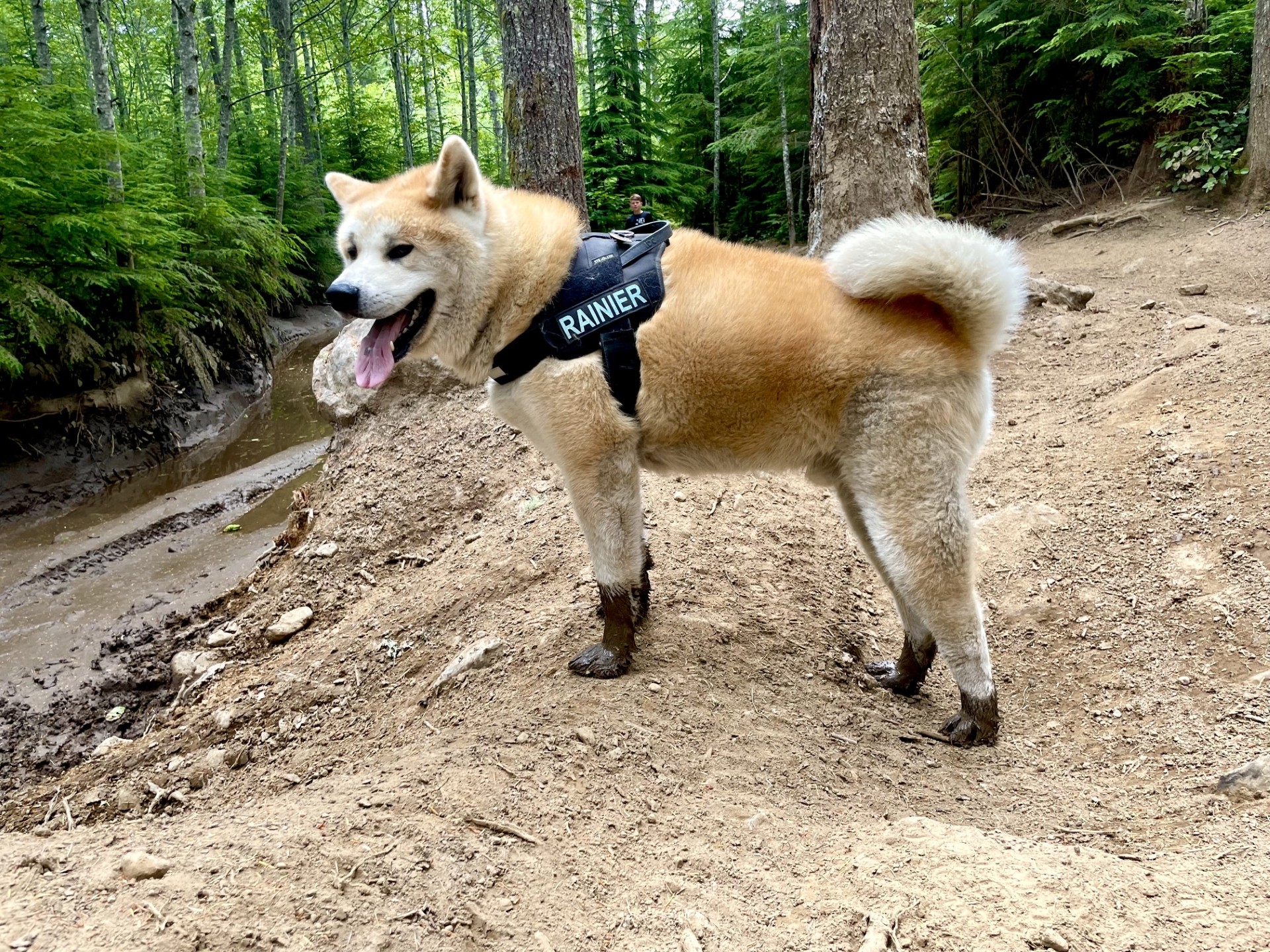
The dog he was
Rainier was born in Fairbanks, Alaska, and carried a love of the outdoors with him throughout his life. He was happiest patrolling his yard, exploring dense forests, chasing critters along the trail, dipping his toes into a cool lake, or simply spending time beside his family. Fiercely loyal, quietly adventurous, with a strong heart and guardian spirit, Rainier found joy in both the wild places we explored together and the ordinary moments at home. More than anything, he just wanted to be wherever his family was.
The diagnosis
It started the way it does for so many families: a limp that wouldn't resolve. Knowing how stoic and strong Akita dogs tend to be, the limp didn’t seem mild, so we took him to an urgent-care veterinarian, expecting an injury or something relatively minor. Instead, imaging revealed something we were completely unprepared for. The word that came back was osteosarcoma — the most common primary bone cancer in dogs, and one of the most aggressive. More than 25,000 dogs in the United States hear some version of that word every year.
Osteosarcoma does not negotiate. Left alone, it hollows the bone it lives in and spreads — almost always to the lungs. Even with the standard playbook, amputation followed by chemotherapy, the cancer returns in the vast majority of dogs within months. Rainier's family learned the statistics the way every family does: too fast, and all at once.
"Rather than only treating the tumor, they taught his own immune system to hunt it."
The fight — and the trial
Instead of stopping at the standard of care, Rainier's family enrolled him in a clinical immunotherapy trial — The Yale EGFR/HER2 Immunotherapy Vaccine — an experimental vaccine designed to stimulate an immune response against the EGFR and HER2 targets found on some cancer cells. It is a different approach from adoptive cell therapies such as ELIAS, and like any trial treatment it carried no promise of a cure. Read Yale's report on the canine cancer vaccine.
Immunotherapy for canine osteosarcoma is genuinely new medicine. Within just the last few years, the field has produced its first fully licensed adoptive cell therapy for canine cancer and multi-center vaccine trials run through the National Cancer Institute's comparative oncology network. Rainier was part of that frontier — a patient whose data and whose fight help the next dog get farther than he could.
Rainier responded remarkably well to treatment. Following his diagnosis, his left front leg was amputated, and he adapted quickly to life on three legs. He then underwent a course of carboplatin chemotherapy, the standard treatment we pursued to address the risk of cancer cells having already spread beyond the original tumor. After completing chemotherapy, Rainier received the experimental EGFR/HER2 canine cancer vaccine. For a time, his cancer remained in remission, giving us something we had desperately hoped for: more good days together. When the cancer later spread to his lungs, Rainier received a booster of the vaccine, and subsequent imaging showed an extraordinary response—the lung metastases regressed. Eventually, osteosarcoma would appear in an unexpected place, his left eye, requiring its removal and another chapter of treatment. Through it all, Rainier kept being Rainier. The time treatment gave us wasn’t spent simply waiting for cancer to return. We explored trails, wandered through the forests he loved, found quiet places near the water, went on adventures, and treasured ordinary days at home together. Cancer became part of his story, but we tried very hard not to let it become his whole life. Rainier lived nearly two years after his osteosarcoma diagnosis—time we once feared we might never have. Every additional season with him reinforced what would eventually become one of the central beliefs behind The Rainier Legacy Project: treatment is not only about adding days to a life. It is about creating the possibility for more walks, more adventures, more ordinary mornings, and more time with the animals we love.
What his fight gave the rest of us
Rainier didn't win in the end. Bone cancer took him, as it takes most of the dogs it touches. But his participation in that trial meant something larger: every dog enrolled in comparative oncology research also advances the science for human osteosarcoma, a disease that has seen no major treatment breakthrough in nearly thirty years.
This project exists so that his fight compounds. So that families facing a diagnosis can find plain-language answers instead of panic. So that the dogs on the other end of that limp have more options than the ones before them. So that he is remembered — by name, and by what he made possible.
For more time. For more dogs.
That sentence is the whole mission. It is what Rainier's family wanted most and couldn't have — and what they are working to give the families who come after them.